
During the spring of 2026, Thailand has carried out its most extensive crackdown to date on so-called nominee shareholder arrangements, namely companies in which Thai nationals are suspected of acting as proxies for foreign investors in order to circumvent the country's restrictive foreign ownership laws. Large-scale police raids have taken place in tourist destinations such as Koh Phangan, Koh Samui, Phuket and Hua Hin. The government has described the operation as a national priority aimed at protecting Thai businesses, jobs and land ownership from unlawful foreign control.
On 1 January, DBD Order No. 2/2568 came into effect. The regulation requires Thai shareholders in newly registered companies to provide evidence of the source of funds used for their share subscriptions through bank statements and similar documentation.
On 1 April, DBD Order No. 1/2569 followed. The requirements were expanded to cover changes in existing companies, including share transfers, capital increases, and changes to boards of directors and authorized signatories.
At the same time, a mandatory "Investment Confirmation Letter" was introduced, requiring each shareholder to certify:
• The source of the investment capital
• That the investment was made using their own funds
• That the information can be supported by banking documentation
In late April, cooperation began between the Department of Lands, the Department of Business Development and other government agencies, enabling direct comparisons between company registries and land ownership records. This makes it significantly easier to identify companies suspected of having been established solely to allow foreigners to indirectly "own" land.
On 9 March, DBD Director-General Poonpong Naiyanapakorn convened representatives from 17 leading law firms to discuss additional measures against the use of nominee shareholders. According to DBD statistics, there are approximately 782,542 active companies in Thailand. Of these, around 118,016 have foreign owners.
The agency also states that Thailand has approximately 980,000 registered legal entities, of which around 118,016 have foreign shareholders within the same ownership range. Authorities estimate that more than 80 percent of companies with such ownership structures may conceal some form of nominee arrangement. DBD states that it has identified approximately 53,000 corporate links deemed suspicious, and these have been referred to other government agencies for further investigation.

Photo: Fishing boats off the coast of Koh Phangan. Photographer: Jens
Authorities have identified six sectors where nominee shareholder arrangements are believed to be particularly common:
• Tourism and tourism-related businesses
• Land and real estate activities
• E-commerce, logistics and warehousing
• Hotels and resort developments
• Agriculture-related businesses
• Construction and contracting activities
The provinces identified as particularly vulnerable are Chon Buri, Chiang Mai, Surat Thani, Phuket and Krabi. At the same time, DBD has begun using its Intelligence Business Analytic System (IBAS) to identify companies displaying classic warning signs. These include businesses in which foreigners own the maximum permitted shareholding while a single authorized signatory exercises full control over operations, or cases where the same Thai individuals repeatedly appear as shareholders or directors in a large number of companies.
On 12 May, Prime Minister Anutin Charnvirakul confirmed that the government had elevated the issue to a national priority. A spokesperson for the Prime Minister's Office stated that Anutin had instructed the Ministry of Commerce, Ministry of Justice, Anti-Money Laundering Office (AMLO), Lawyers Council of Thailand and Federation of Accounting Professions to intensify efforts against such nominee arrangements.
The decision followed investigations showing that certain lawyers, accountants and other advisers had actively assisted foreigners in circumventing the Foreign Business Act. The Prime Minister emphasized that foreign investment remains welcome in Thailand as long as the law is followed, but that the government will not tolerate arrangements that distort competition or negatively affect Thai businesses and workers.
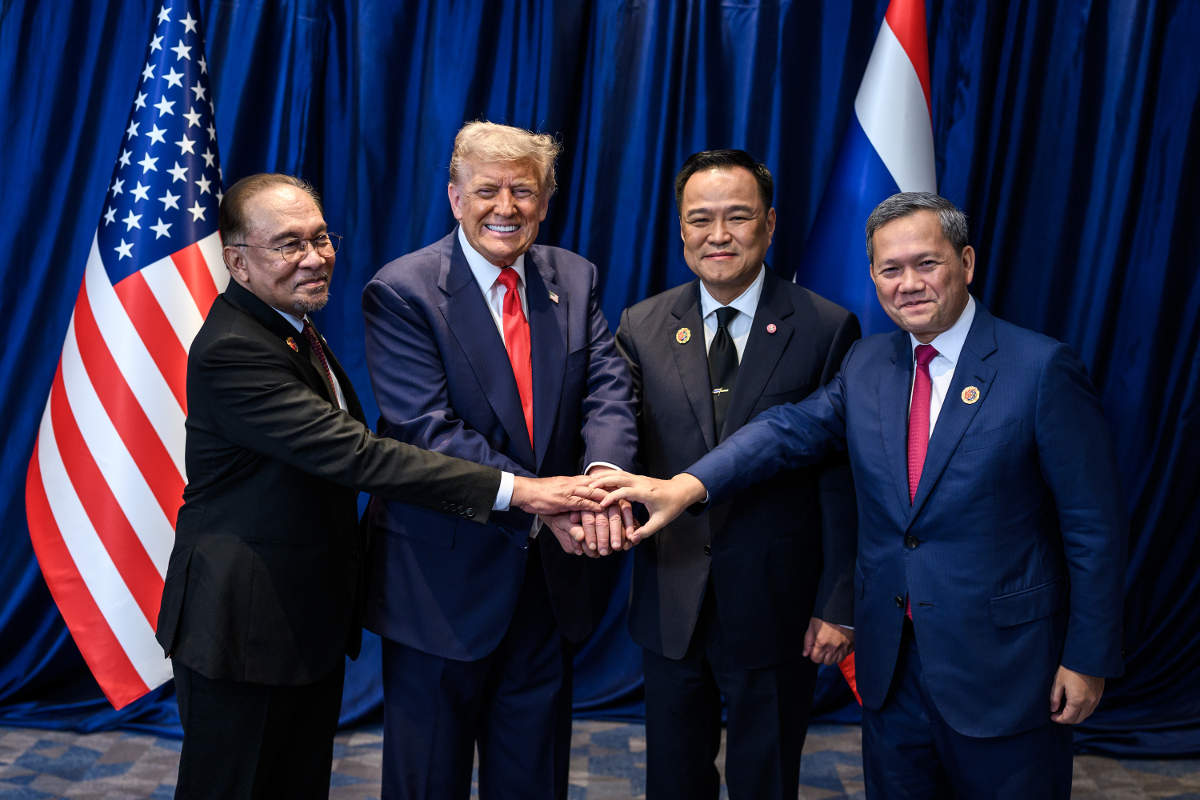
Photo: Thailand's Prime Minister Anutin Charnvirakul (third from left) with Anwar Ibrahim, Donald Trump and Hun Manet. Photographer: Daniel Torok / The White House
Shortly thereafter, DBD released the results of a survey of company registrations in the country's most important tourist destinations. The statistics showed:
• Pattaya (Bang Lamung): 33,314 registered companies, of which 19,910 have foreign owners
• Phuket: 29,646 companies, of which 11,626 have foreign owners
• Koh Samui: 12,050 companies, of which 8,213 have foreign owners
• Hua Hin: 4,061 companies, of which 2,081 have foreign owners
• Koh Phangan: 3,754 companies, of which 2,381 have foreign owners
Authorities decided that these areas would become priority targets for continued inspections.
On 13 May, the first phase began with a major operation on Koh Phangan in Surat Thani Province. The operation was led by Pol Gen Samran Nualma, Deputy National Police Chief and head of the Centre for Suppression of Transnational Crime and Illegal Immigration. Police, tax authorities, land officials, labour authorities and DBD conducted raids on 24 tourism-related businesses suspected of being controlled by foreigners through Thai nominee shareholders.
Authorities investigated a total of 37 cases and carried out 27 search warrants. The focus was on law offices, accounting firms and businesses specializing in the creation of nominee shareholder arrangements. According to DBD, Israelis constituted the largest foreign investor group on the island, followed by French and British nationals.
When the second phase was carried out, more than 300 police officers participated. Under the command of Pol Lt Gen Noppasin Poolsawat, coordinated raids were conducted on 36 properties and businesses following orders issued by Koh Samui Provincial Court. Police investigated 39 separate cases and obtained 45 arrest warrants for foreign nationals suspected of violating the Foreign Business Act and the Land Code.
Initially, 32 companies were identified as pure nominee structures. Twenty-two foreign nationals were arrested, and authorities seized 45 land plots covering more than 40 rai, with an estimated value exceeding 200 million baht. The suspects were charged, among other offences, with operating businesses without authorization and unlawful land ownership.
A further 32 companies are under investigation, where foreign shareholders are suspected of controlling larger stakes than their Thai partners. These companies controlled more than 38 rai of land, mainly undeveloped.
Twenty-one of the companies were searched to secure additional evidence. Thirty-two Thai nationals and 30 foreign nationals were suspected of offences. Following the arrests, police announced that bail would not be granted for 21 of the detained foreign suspects at Samui Provincial Court.
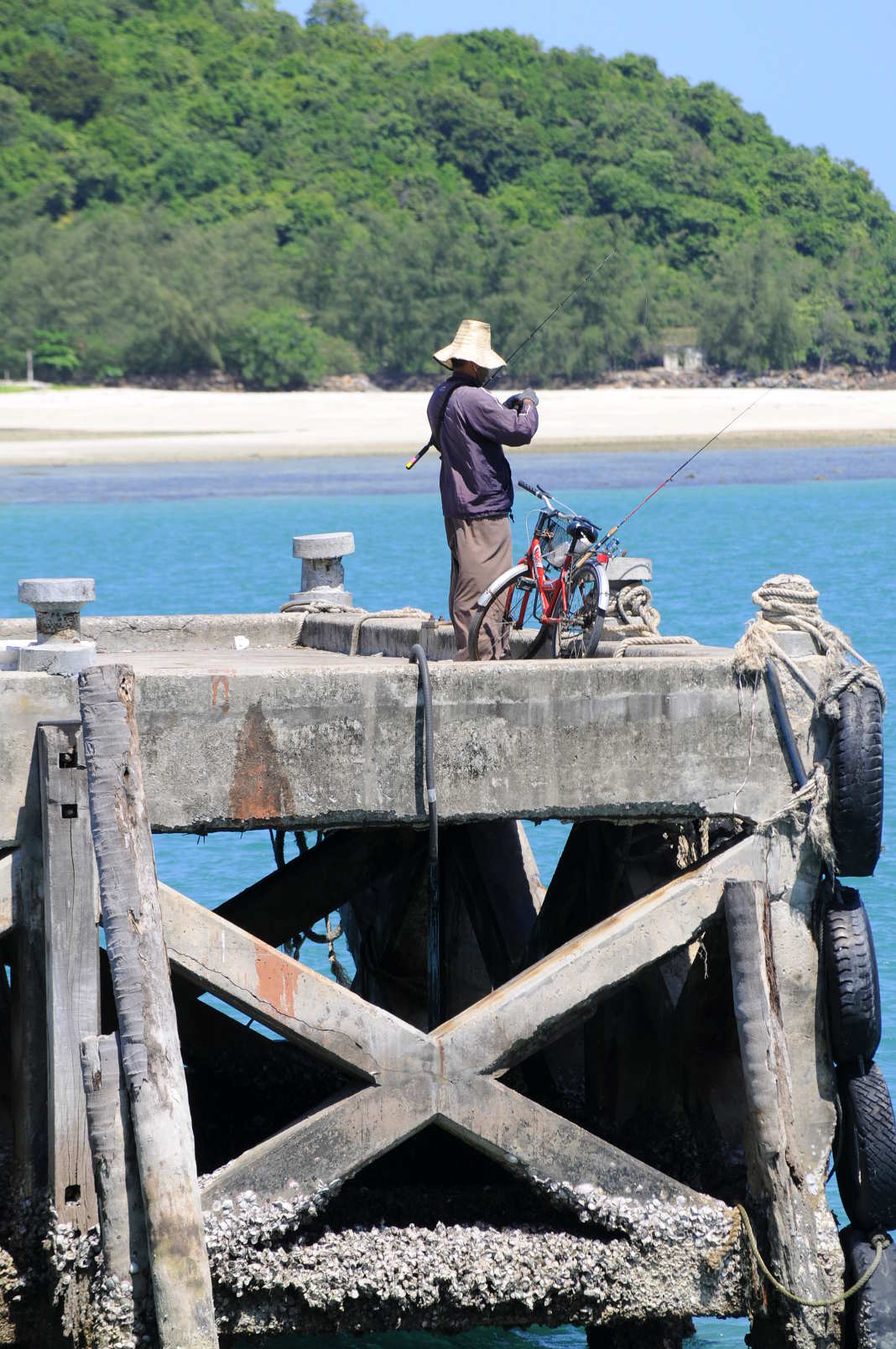
Photo: A Thai fisherman in Thong Sala, on the west coast of Koh Phangan. Photographer: Jens
At the end of May, it was reported that approximately 2,000 companies in the Hua Hin area had been identified for further review. Investigators focused in particular on:
• Companies with significant property holdings but limited operational activity
• Shareholders whose declared income did not match the size of their investments
• Companies with shared nominee shareholders
• Companies registered at addresses inconsistent with their stated business activities
On 1 June, the Economic Crime Suppression Division (ECSD) carried out a large-scale operation targeting a network of nominee companies in Phuket. During the operation, authorities seized:
• 225 bank accounts with more than 300 million baht in transaction volume
• 245 land title deeds
• Documents linked to 196 condominium units valued at approximately 1 billion baht
• Records relating to around 800 companies
• 1,601 company seals
Investigators found that an accounting firm in Phuket had organized the formation of all the companies and used employees and their relatives as nominee shareholders. As the investigation expanded, authorities uncovered links to a total of 272 companies, including 130 suspected nominee companies operating in real estate, tourism and service sectors. These companies had a combined registered capital of 679 million baht. In total, 231 individuals were arrested or charged. Among the suspects were 98 foreign nationals accused of operating businesses without permission, and 37 Thai nationals suspected of acting as nominees for foreign-controlled companies.
The government has also issued repeated warnings to Thai citizens acting as nominee shareholders. Authorities emphasize that both the foreign investor and the Thai nominee can be prosecuted under the Foreign Business Act. Penalties may include up to three years’ imprisonment and fines ranging from 100,000 to 1 million baht.
In addition, those involved risk company dissolution, forced land sales, asset seizures, AMLO investigations, tax audits, visa revocations, blacklisting and deportation.
The year 2026 can be described as a turning point for foreign property owners in Thailand. Structures involving nominee shareholders, which have been used for decades to circumvent restrictions under the Land Code and the Foreign Business Act, are now being scrutinized through bank records, registry cross-checks and coordinated law enforcement operations.
According to several legal experts and law firms, the crackdown remains in an early stage, and cooperation between the Department of Business Development (DBD), the Department of Lands, the Royal Thai Police, AMLO and other agencies is expected to intensify further.
The government’s message is clear: foreign investment is welcome, but the use of Thai nominees to circumvent the law will no longer be tolerated.
Sources:
• Bangkok Post
• The Nation Thailand
• Thai Examiner