
The price of gold has indeed risen sharply in recent years. In Thailand, this precious metal has held a unique cultural and societal position for hundreds of years. Here, we take a closer look at Thai gold – its historical background, cultural significance, and practical uses.
In Thailand, gold is far more than rings, bracelets, and necklaces. This precious metal carries a deep cultural, religious, and economic meaning that extends far beyond the jewelry counter. Historically, the region has had strong connections to gold. Thailand was formerly known as Siam, and some believe the name has links to Sanskrit words associated with gold. In older Chinese sources, the region is sometimes described as a “golden peninsula.”
In Thai culture, gold frequently appears as a symbol of purity and spirituality. This is particularly evident in depictions of Buddha, who is often associated with a golden radiance. Even today, gold plays a central role in Buddhist contexts – from massive gold objects to statues covered with a thin layer of gold, and to gold leaf that temple visitors apply to surfaces as an expression of respect and reverence.
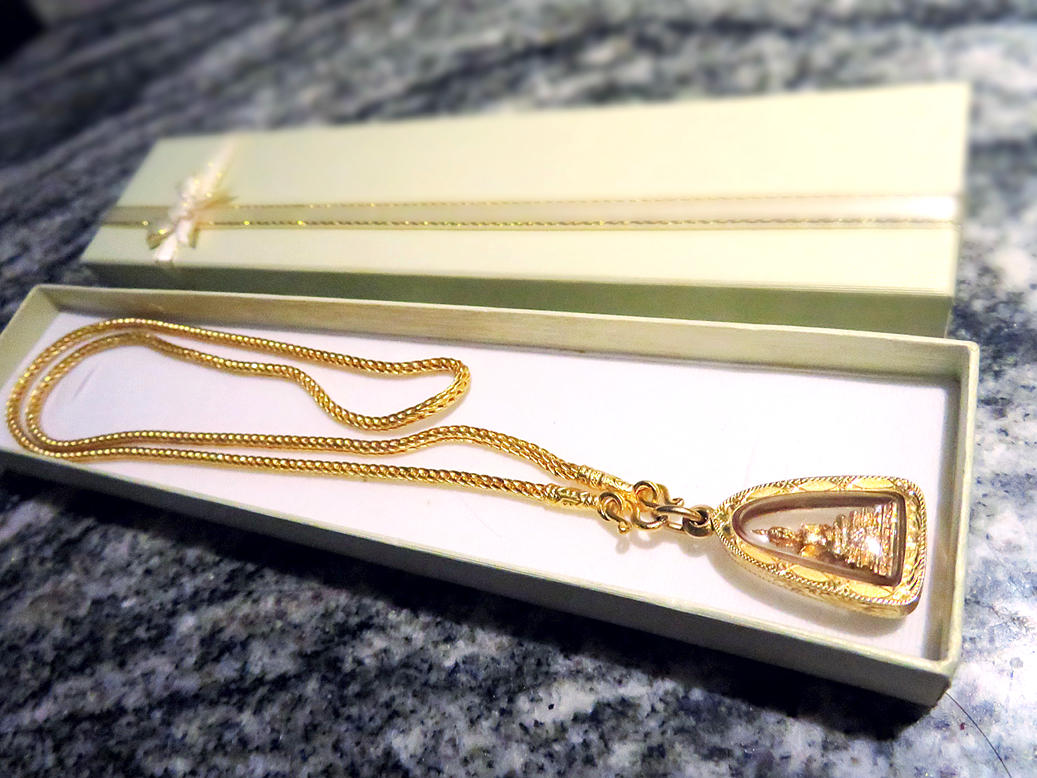
Image: A 23 karat necklace with a Buddha amulet in a gift box. Photographer: Jens
A central aspect of gold’s role in Thailand is its function as financial security. Many Thai people also view their gold jewelry as a form of savings. When needed, jewelry can be pawned or sold to access cash. This system is well established, and most gold shops offer loans under relatively favorable conditions. Gold thus acts as an economic buffer – especially during financially challenging times.
The Thai currency is called baht, but the term is also used as a unit of weight for gold. Historically, this originated from Chinese gold traders using the weight of Thai baht coins at the time as a reference. One baht of gold weighs 15.244 grams before processing. After the jewelry has been manufactured, the weight must be at least 15.16 grams to be classified as a full baht.
Thai gold jewelry and gold bars usually consist of 96.5% gold, corresponding to 23 karats. They are therefore often stamped with the number “965.” The remaining 3.5% consists of other metals, typically silver or copper, which provide increased durability. Since the markup for design and craftsmanship is often low in Thailand, many choose to invest in gold jewelry rather than investment gold such as gold bars and coins.
This high level of purity differs from what is common in, for example, Europe and North America, where 18 karat (75% gold) or 14 karat (approximately 58.3%) is more common. In recent times, lower karat levels have also become somewhat more common in Thailand, partly due to international influences. However, 23 karat remains the standard.
A higher gold content makes the metal softer, meaning that 23 karat jewelry is more easily scratched and deformed than pieces with lower purity. For everyday use, a lower karat may therefore be more practical. Wedding rings are one example of jewelry that can be scratched and deformed if the karat level is high.
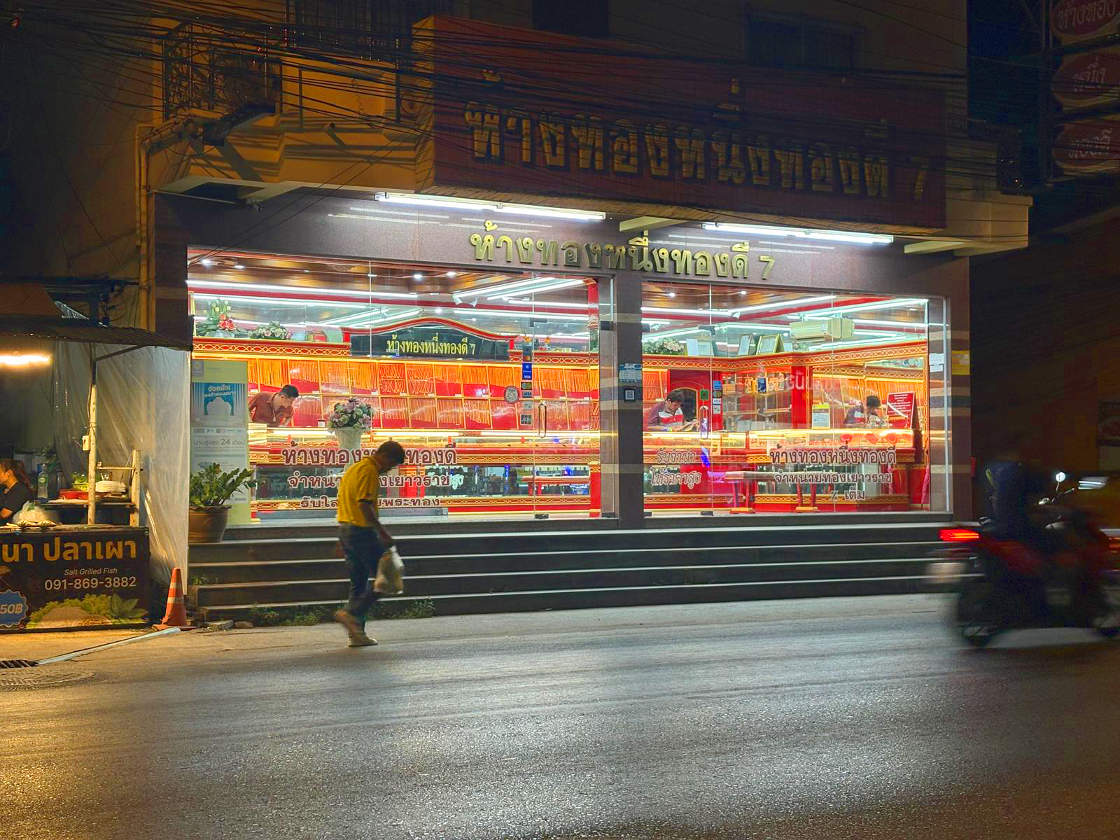
Image: A traditional Thai gold shop, just before closing. Photographer: Jens
Thai gold has an intensely yellow color, which is a direct result of its high purity. Gold with a lower karat level generally has a more subdued tone. The appearance is largely influenced by the alloying metals used, such as copper, silver, and palladium.
Thailand has a long tradition of goldsmithing, with classic styles such as Sukhothai and Petchburi. Both are characterized by great attention to detail and high craftsmanship, and can be found in shops across the country.
The largest concentration of gold shops is in Bangkok, particularly in Chinatown along Yaowarat Road. The shops are often located close together, and the selection is extensive. At the same time, gold shops can be found in virtually every city, and sometimes even in smaller towns. They are often recognizable by their red signs and display cases – a color that in Chinese culture symbolizes luck and prosperity.
The gold trade in Thailand is strictly regulated, and it is illegal to mislead customers regarding weight and purity. If an offer seems too good to be true, it almost always is. No serious seller offers gold below market price. Never buy gold from private individuals or street vendors – the risk of fraud is significant.
• Check that the current gold price is clearly displayed in the shop
• Compare several shops before making a decision
• Avoid dealers who do not openly display price and karat level
• Observe customer flow – shops with many local customers are often reliable
A piece of gold jewelry from Thailand is often more than just a purchase. It can be an investment, but also a memory – something that carries the story of a journey, a place, and a culture.
• Chemical symbol: Au
• Atomic number: 79
• Density: 19.32 g/cm³
• Melting point: 1064 °C
• Boiling point: 2807 °C
• Phase at STP: Solid
• Hip-hop factor: Still high :)